
Novogene AMEA
  • Novogene AMEA
  • Genomics
    • Human Whole Genome Sequencing
    • Plant and Animal Whole Genome Sequencing
    • Microbial Whole Genome Sequencing
    • Plant and Animal De novo Sequencing
    • Microbial De novo Sequencing
    • Shotgun Metagenomics Sequencing
    • Amplicon Sequencing
    • Whole Exome Sequencing
    Transcriptomics
    • mRNA Sequencing
    • Total RNA Sequencing
    • Full-Length Transcriptome Sequencing
    • Whole Transcriptome Sequencing
    • Small RNA Sequencing
    • Circular RNA Sequencing
    • Metatranscriptome Sequencing
    • Prokaryotic RNA Sequencing
    Single Cell & Spatial Omics
    • Single Cell Gene Expression
    • Single Cell Immune Profiling Sequencing
    • Single Cell Long Read Transcriptome
    • Visium HD Spatial Gene Expression
    • Stereo-Seq Spatial Gene Expression
    • Xenium In Situ Spatial Transcriptome
    Epigenomics
    • Whole Genome Bisulfite Sequencing (WGBS)
    • Directed DNA Methylation Sequencing (DM-Seq) NEW
    • Reduced Representation Bisulfite Sequencing (RRBS)
    • Chromatin Immunoprecipitation Sequencing (ChIP-seq)
    • RNA Immunoprecipitation Sequencing (RIP-seq)
    • Assay for Transposase-Accessible Chromatin with Sequencing (ATAC-seq)

    Premade Library

    • Sequencing Only on Illumina Sequencer
    • Sequencing Only on PacBio Sequencer
    Proteomics and Metabolomics
    • Olink Proteomics
    • Quantitative Proteomics
    • Untargeted Metabolomics
  • PromotionsPromotions
    • Platforms
    • Automated Delivery Platform (Falcon)
    • Bioinformatics Analysis Tool (NovoMagic)
    • Customer Service System (CSS)
    • Brochures
    • Case Studies
    • Webinar
    • Blog
    • Sample Guidelines
    • Cancer Research
    • Immuno-oncology
    • Agrigenomics
    • Environment
    • Food Science
    • Human Microbiome
    • Plant and Animal Microbiome
    • Drug Discovery and Development
    • Rare and Complex Diseases
    • About Us
    • Our Locations
    • News
    • Careers
  • Contact UsContact Us
  1. Home
  2. Resources
  3. Blog
  4. Four Powered Online Tools for Genomic Analysis and Visualization (I) - getorf

Four Powered Online Tools for Genomic Analysis and Visualization (I) - getorf

I.getorf – ORF prediction

Open Reading Frames (ORFs) represent a region of specified minimum size between two STOP codons, or between a START and a STOP codon. To predict and annotate ORFs in a sequence, ORF prediction tools are commonly used. getorf is an (online) software tool that finds and extracts open reading frames present in any sequence that a user can feed as an input. It is a command line program from EMBOSS (the European Molecular Biology Open Software Suite), and a part of Nucleic: Gene finding command groups.

getorf can work with either a single or multiple nucleotide sequence. The program takes a standard EMBOSS sequence query (also known as ‘USA’) as an input which mainly includes srs:embl, srs:uniprot and esembl, as defined in EMBOSS installations. Alternatively, data can also be read from sequences written by an EMBOSS or other third-party application as long as it is a supported format. The format of the input can be specified using command-line qualifier – sformat ‘xxx’, where ‘xxx’ is replaced by the format name. Formats that are available are: gff (gff3), gff2, embl (em), genbank (gb, refseq), ddbj, refseqp, pir (nbrf), swissprot (swiss, sw), dasgff and debug. Once the input format and sequence are defined, then the tool can be used in a pretty straight-forward way from the interface, as below. The search can customize by different parameters such as the organism, minimum/maximum size of the ORF to report, the type of sequence (circular/linear), number of flanking nucleotides to report. Additionally, the type of output and its format can also be defined according to the need. When dealing with relatively larger sequences, one can opt to receive the results in email as well[1].
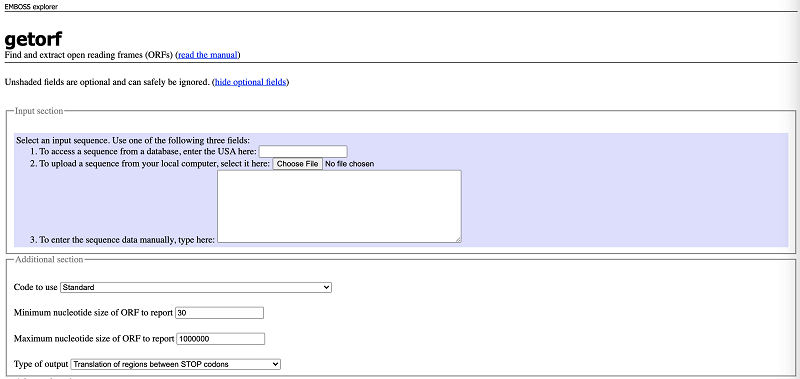
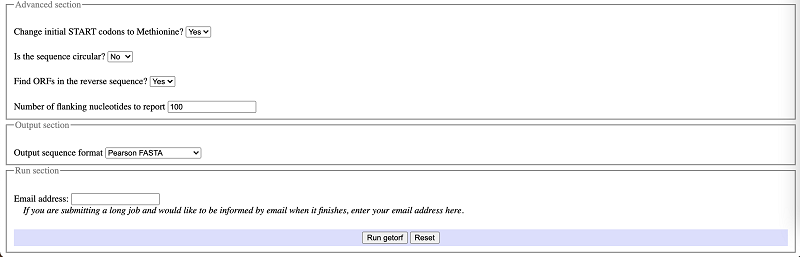
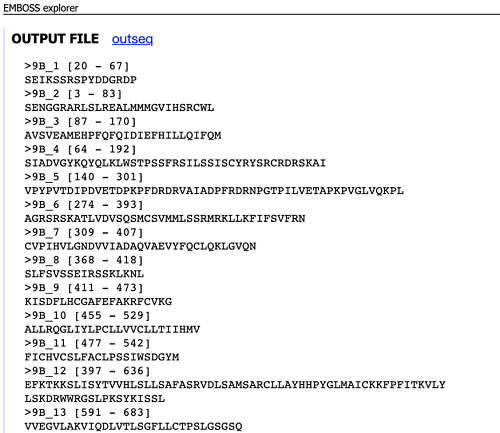
There are three ways to upload the sequences. After sequence input, click ‘Run getorf’ and you will get output like the sequence shown below. And finally copy and save the results and you can use blastp to do the successive analysis.
To be continued…

Reference: [1] http://emboss.sourceforge.net/apps/cvs/emboss/apps/getorf.html

ServicesServices menu

SupportSupport menu

CompanyCompany menu

Services
Whole Genome SequencingDe novo SequencingAmplicon SequencingShotgun Metagenomic SequencingDirected DNA Methylation Sequencing (DM-Seq)mRNA SequencingSingle Cell Gene ExpressionVisium HD Spatial Gene ExpressionXenium In Situ Spatial TranscriptomeOlink ProteomicsUntargeted Metabolomics
Support
NovoMagic Bioinformatics Analysis ToolCustomer Service SystemFalcon Intelligent Delivery Platform
Company
About UsOur LocationsOur PlatformsNewsCareersContact Us
LinkedInLinkedIn hoverYouTubeYouTube hoverXX hover
Copyright © 2026 Novogene Inc. All rights reserved.For Research Use Only. Not for Clinical Diagnostic Use.
Novogene AMEA
  • Novogene AMEA
  • Genomics
    • Human Whole Genome Sequencing
    • Plant and Animal Whole Genome Sequencing
    • Microbial Whole Genome Sequencing
    • Plant and Animal De novo Sequencing
    • Microbial De novo Sequencing
    • Shotgun Metagenomics Sequencing
    • Amplicon Sequencing
    • Whole Exome Sequencing
    Transcriptomics
    • mRNA Sequencing
    • Total RNA Sequencing
    • Full-Length Transcriptome Sequencing
    • Whole Transcriptome Sequencing
    • Small RNA Sequencing
    • Circular RNA Sequencing
    • Metatranscriptome Sequencing
    • Prokaryotic RNA Sequencing
    Single Cell & Spatial Omics
    • Single Cell Gene Expression
    • Single Cell Immune Profiling Sequencing
    • Single Cell Long Read Transcriptome
    • Visium HD Spatial Gene Expression
    • Stereo-Seq Spatial Gene Expression
    • Xenium In Situ Spatial Transcriptome
    Epigenomics
    • Whole Genome Bisulfite Sequencing (WGBS)
    • Directed DNA Methylation Sequencing (DM-Seq) NEW
    • Reduced Representation Bisulfite Sequencing (RRBS)
    • Chromatin Immunoprecipitation Sequencing (ChIP-seq)
    • RNA Immunoprecipitation Sequencing (RIP-seq)
    • Assay for Transposase-Accessible Chromatin with Sequencing (ATAC-seq)

    Premade Library

    • Sequencing Only on Illumina Sequencer
    • Sequencing Only on PacBio Sequencer
    Proteomics and Metabolomics
    • Olink Proteomics
    • Quantitative Proteomics
    • Untargeted Metabolomics
  • PromotionsPromotions
    • Platforms
    • Automated Delivery Platform (Falcon)
    • Bioinformatics Analysis Tool (NovoMagic)
    • Customer Service System (CSS)
    • Brochures
    • Case Studies
    • Webinar
    • Blog
    • Sample Guidelines
    • Cancer Research
    • Immuno-oncology
    • Agrigenomics
    • Environment
    • Food Science
    • Human Microbiome
    • Plant and Animal Microbiome
    • Drug Discovery and Development
    • Rare and Complex Diseases
    • About Us
    • Our Locations
    • News
    • Careers
  • Contact UsContact Us
  1. Home
  2. Resources
  3. Blog
  4. Four Powered Online Tools for Genomic Analysis and Visualization (I) - getorf

Four Powered Online Tools for Genomic Analysis and Visualization (I) - getorf

I.getorf – ORF prediction

Open Reading Frames (ORFs) represent a region of specified minimum size between two STOP codons, or between a START and a STOP codon. To predict and annotate ORFs in a sequence, ORF prediction tools are commonly used. getorf is an (online) software tool that finds and extracts open reading frames present in any sequence that a user can feed as an input. It is a command line program from EMBOSS (the European Molecular Biology Open Software Suite), and a part of Nucleic: Gene finding command groups.

getorf can work with either a single or multiple nucleotide sequence. The program takes a standard EMBOSS sequence query (also known as ‘USA’) as an input which mainly includes srs:embl, srs:uniprot and esembl, as defined in EMBOSS installations. Alternatively, data can also be read from sequences written by an EMBOSS or other third-party application as long as it is a supported format. The format of the input can be specified using command-line qualifier – sformat ‘xxx’, where ‘xxx’ is replaced by the format name. Formats that are available are: gff (gff3), gff2, embl (em), genbank (gb, refseq), ddbj, refseqp, pir (nbrf), swissprot (swiss, sw), dasgff and debug. Once the input format and sequence are defined, then the tool can be used in a pretty straight-forward way from the interface, as below. The search can customize by different parameters such as the organism, minimum/maximum size of the ORF to report, the type of sequence (circular/linear), number of flanking nucleotides to report. Additionally, the type of output and its format can also be defined according to the need. When dealing with relatively larger sequences, one can opt to receive the results in email as well[1].

There are three ways to upload the sequences. After sequence input, click ‘Run getorf’ and you will get output like the sequence shown below. And finally copy and save the results and you can use blastp to do the successive analysis.

To be continued…

Reference: [1] http://emboss.sourceforge.net/apps/cvs/emboss/apps/getorf.html

ServicesServices menu

SupportSupport menu

CompanyCompany menu

Services
Whole Genome SequencingDe novo SequencingAmplicon SequencingShotgun Metagenomic SequencingDirected DNA Methylation Sequencing (DM-Seq)mRNA SequencingSingle Cell Gene ExpressionVisium HD Spatial Gene ExpressionXenium In Situ Spatial TranscriptomeOlink ProteomicsUntargeted Metabolomics
Support
NovoMagic Bioinformatics Analysis ToolCustomer Service SystemFalcon Intelligent Delivery Platform
Company
About UsOur LocationsOur PlatformsNewsCareersContact Us
LinkedInLinkedIn hoverYouTubeYouTube hoverXX hover
Copyright © 2026 Novogene Inc. All rights reserved.For Research Use Only. Not for Clinical Diagnostic Use.
Privacy PolicyCookie PolicyCareers