
Novogene AMEA
  • Novogene AMEA
  • Genomics
    • Human Whole Genome Sequencing
    • Plant and Animal Whole Genome Sequencing
    • Microbial Whole Genome Sequencing
    • Plant and Animal De novo Sequencing
    • Microbial De novo Sequencing
    • Shotgun Metagenomics Sequencing
    • Amplicon Sequencing
    • Whole Exome Sequencing
    Transcriptomics
    • mRNA Sequencing
    • Total RNA Sequencing
    • Full-Length Transcriptome Sequencing
    • Whole Transcriptome Sequencing
    • Small RNA Sequencing
    • Circular RNA Sequencing
    • Metatranscriptome Sequencing
    • Prokaryotic RNA Sequencing
    Single Cell & Spatial Omics
    • Single Cell Gene Expression
    • Single Cell Immune Profiling Sequencing
    • Single Cell Long Read Transcriptome
    • Visium HD Spatial Gene Expression
    • Stereo-Seq Spatial Gene Expression
    • Xenium In Situ Spatial Transcriptome
    Epigenomics
    • Whole Genome Bisulfite Sequencing (WGBS)
    • Directed DNA Methylation Sequencing (DM-Seq) NEW
    • Reduced Representation Bisulfite Sequencing (RRBS)
    • Chromatin Immunoprecipitation Sequencing (ChIP-seq)
    • RNA Immunoprecipitation Sequencing (RIP-seq)
    • Assay for Transposase-Accessible Chromatin with Sequencing (ATAC-seq)

    Premade Library

    • Sequencing Only on Illumina Sequencer
    • Sequencing Only on PacBio Sequencer
    Proteomics and Metabolomics
    • Olink Proteomics
    • Quantitative Proteomics
    • PTM Proteomics NEW
    • Untargeted Metabolomics
  • PromotionsPromotions
    • Platforms
    • Automated Delivery Platform (Falcon)
    • Bioinformatics Analysis Tool (NovoMagic)
    • Customer Service System (CSS)
    • Brochures
    • Case Studies
    • Webinar
    • Blog
    • Sample Guidelines
    • Community
    • Cancer Research
    • Immuno-oncology
    • Agrigenomics
    • Environment
    • Food Science
    • Human Microbiome
    • Plant and Animal Microbiome
    • Drug Discovery and Development
    • Rare and Complex Diseases
    • About Us
    • Our Locations
    • News
    • Careers
  • Contact UsContact Us
  1. Home
  2. Resources
  3. Blog
  4. From Data to Discovery: How Multi-Omics Is Rewriting the Future of Gut Health

From Data to Discovery: How Multi-Omics Is Rewriting the Future of Gut Health

Sponsored technical content from Novogene

Inside your digestive tract lives a bustling microscopic city, trillions of bacteria, fungi, viruses, and other microorganisms working, competing, and communicating around the clock. Researchers have now cataloged over 200,000 reference genomes and 170 million predicted protein sequences from this community, yet what most of these genes actually do remains unknown.[1] For decades, microbiome research could describe much of this community, but one question remained stubbornly difficult: what are these microbes actually doing?

That is where modern multi-omics changes the conversation. Shotgun metagenomics provides the foundation. It reveals the microbial blueprint: who is present, which genes they carry, and what functions they may be capable of. Metatranscriptomics adds the active voice. Metabolomics captures the chemical messages. Integrative analysis brings these signals together into a more complete biological story.[2][3][4][5]
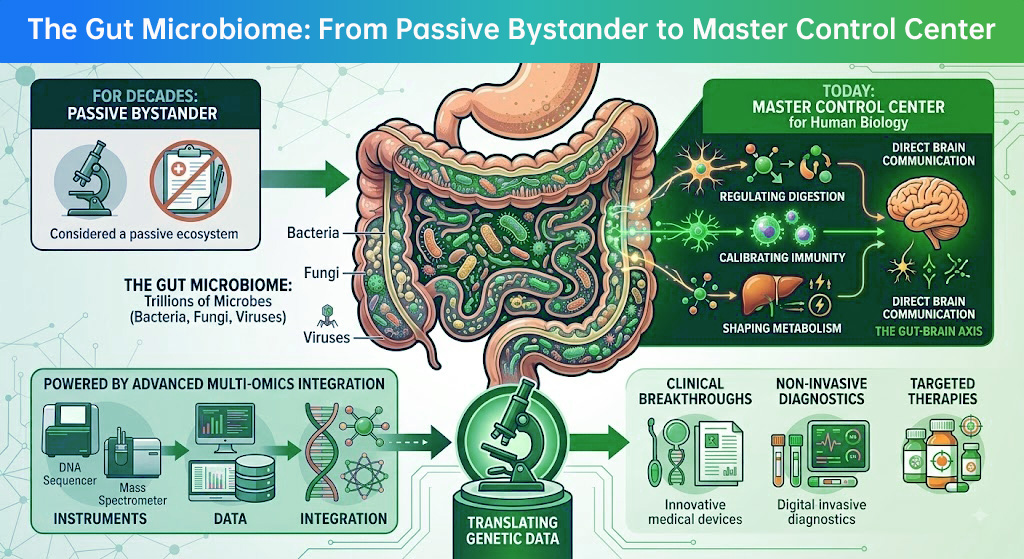
The gut microbiome: from passive bystander to master control center

1. The Foundation: Shotgun Metagenomics

Traditional 16S rRNA sequencing offers a useful community overview. But it is still a little like identifying the buildings in a city without seeing what happens inside them.

Shotgun metagenomics takes a broader view by sequencing DNA directly from the microbial community. It can help researchers investigate:

  • Community composition at higher taxonomic resolution.
  • Genes, pathways, and functional modules.
  • Antimicrobial-resistance and virulence-associated features.
  • Genomic variation across samples.
  • Species- or strain-level differences when sequencing depth, sample quality, community complexity, and reference databases are suitable.[6][7][8]

By avoiding the primer design required for targeted amplicon workflows, shotgun sequencing can reduce certain primer-related biases. It is not bias-free: extraction method, host-DNA contamination, sequencing depth, reference databases, and computational choices all shape the final picture.[7]

The key output is functional potential, what the microbial community may be equipped to do.

2. The Supporting Cast: RNA and Metabolites

A blueprint tells us what could happen. It does not tell us what is happening under a particular set of conditions. That is where the next layers of omics enter the story.

  • Metatranscriptomics: the active voice
    • Possessing a gene does not mean that gene is switched on. Metatranscriptomic RNA sequencing provides a snapshot of microbial gene expression at the moment of sampling.[4][5]
    • It can help researchers investigate how microbial functions respond to disease states, diets, treatments, environmental conditions, or experimental interventions. But transcripts are not the same as proteins, metabolic flux, or biological outcomes. RNA stabilization, extraction, normalization, and validation remain essential parts of the investigation.
  • Metabolomics: the chemical messenger
    • Microbes communicate with their surroundings through chemistry. Metabolomics helps researchers measure the small molecules involved in that conversation, including short-chain fatty acids, bile acids, tryptophan metabolites, and other compounds linked to host metabolism.[9][10]
    • Untargeted metabolomics scans broadly for discovery. Targeted metabolomics focuses on selected compounds when precise quantification is required. A detected metabolite should not automatically be labelled microbial; host metabolism, diet, medication, and environmental factors may also leave their fingerprints.

Together, the layers create a richer picture:

Metagenomics shows what may be possible. Metatranscriptomics shows what may be expressed. Metabolomics shows what chemical signals are present.
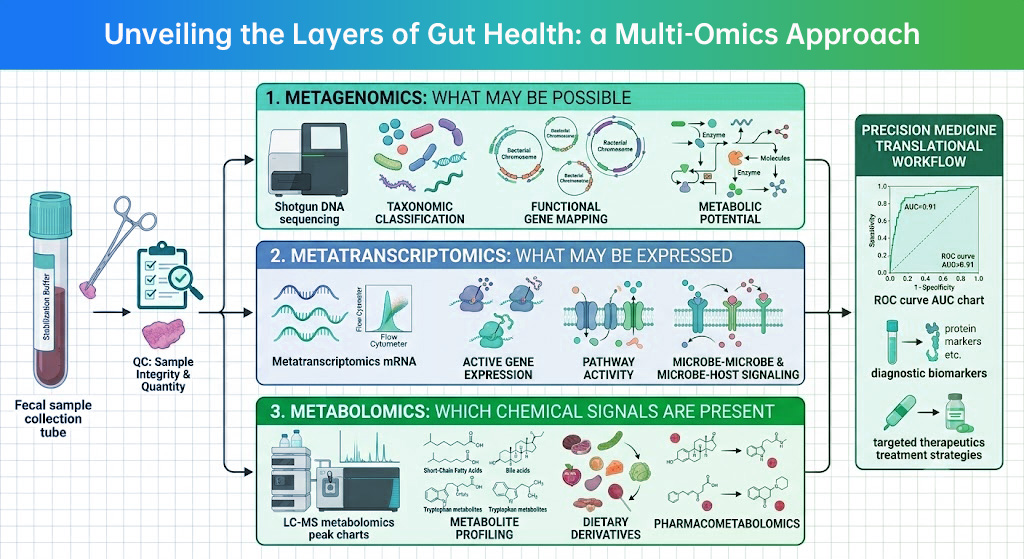
Unveiling the layers of gut health: a multi-omics approach

3. The Integrative Layer: Bringing the Data Together

The real power of multi-omics appears when these data layers stop being viewed as separate reports and start answering the same research question. Shotgun metagenomics may identify a microbial pathway. Metatranscriptomics may show whether related genes are being expressed. Metabolomics may reveal a chemical feature that changes alongside them. The next question is whether these signals are connected.

To answer that, integrative workflows generate several layers of evidence:

  • Correlation heatmaps and scatterplots reveal which microbes and metabolites move in lockstep, the first hint that a biological relationship exists.
  • Chord diagrams, networks, and Sankey diagrams turn those pairwise links into visual maps of cross-kingdom crosstalk, making complex patterns readable at a glance.
  • Canonical correlation analysis (CCA) identifies coordinated variation across entire datasets, surfacing shared axes of biological change rather than isolated correlations.
  • O2PLS data integration separates shared biological signals from dataset-specific noise, helping researchers distinguish true coupling from technical artifact.

Across a typical project, these tools compress taxonomic and functional profiles, differential feature tables, and correlation maps into a shortlist of integrated candidate pathways ready for experimental follow-up.

Correlation and multivariate integration identify associations and shared patterns. They do not, by themselves, prove that one microorganism produced a metabolite or caused a phenotype. Stronger mechanistic conclusions require perturbation, controlled models, orthogonal assays, independent replication, and, where appropriate, human studies.[2]

4. From Signal to Hypothesis: Alistipes indistinctus and Hippuric Acid

One study offers a clear example of this progression. Researchers used integrative metagenomic and metabolomic analysis to investigate hyperuricemia, identifying a relationship involving Alistipes indistinctus and hippuric acid.[11] The work then moved beyond the initial association. Mechanistic experiments linked hippuric acid with intestinal urate excretion through pathways involving PPARγ, ABCG2, and PDZK1.[11]

The lesson is not that a single correlation has solved a disease. It is that multi-omics can help turn a broad microbial signal into a focused microbial–metabolite–host hypothesis, one that can be investigated experimentally.[2]

5. Turning Microbiome Data into Discovery with Novogene

From sample preparation and sequencing to transcriptomics, metabolomics, visualization, and integration, every stage shapes the quality of the final biological story.

Novogene supports researchers across this multi-omics journey, from shotgun metagenomics and microbial genome analysis to metatranscriptomics, metabolomics, bioinformatics, visualization, and integrative analysis. The appropriate combination of technologies depends on the research question, sample type, cohort design, metadata, desired resolution, and validation plan.

The goal is not simply to generate more data. It is to help researchers identify the signals, relationships, and pathways that deserve a closer look.

Book a study-design consultation with Novogene to discuss your sample type, sequencing strategy, complementary omics requirements, analytical outputs, and validation plan.
References
  1. Almeida A, Nayfach S, Boland M, et al. A unified catalog of 204,938 reference genomes from the human gut microbiome. Nat Biotechnol. 2021;39(1):105–114.
  2. Wu J, Singleton SS, Bhuiyan U, Krammer L, Mazumder R. Multi-omics approaches to studying gastrointestinal microbiome in the context of precision medicine and machine learning. Front Mol Biosci. 2024;10:1337373.
  3. Valles-Colomer M, Menni C, Berry SE, et al. Cardiometabolic health, diet and the gut microbiome: a meta-omics perspective. Nat Med. 2023;29(3):551–561.
  4. Van Hul M, Cani PD. From microbiome to metabolism: bridging a two-decade translational gap. Cell Metab. 2026;38(1):14–32.
  5. Yang SY, Han SM, Lee JY, Kim KS, Lee JE, Lee DW. Advancing gut microbiome research: the shift from metagenomics to multi-omics and future perspectives. J Microbiol Biotechnol. 2025;35:e2412001.
  6. Jovel J, Patterson J, Wang W, et al. Characterization of the gut microbiome using 16S or shotgun metagenomics. Front Microbiol. 2016;7:459.
  7. Meyer F, Fritz A, Deng ZL, et al. Critical Assessment of Metagenome Interpretation: the second round of challenges. Nat Methods. 2022;19(4):429–440.
  8. Li D, Liu CM, Luo R, et al. MEGAHIT: an ultra-fast single-node solution for large and complex metagenomics assembly via succinct De Bruijn graph. Bioinformatics. 2015;31(10):1674–1676.
  9. Pedersen HK, Gudmundsdottir V, Nielsen HB, et al. Human gut microbes impact host serum metabolome and insulin sensitivity. Nature. 2016;535(7612):376–381.
  10. Wishart DS. Metabolomics for investigating physiological and pathophysiological processes. Physiol Rev. 2019;99(4):1819–1875.
  11. Xu YX, Liu LD, Zhu JY, et al. Alistipes indistinctus-derived hippuric acid promotes intestinal urate excretion to alleviate hyperuricemia. Cell Host Microbe. 2024;32(3):366–381.

ServicesServices menu

SupportSupport menu

CompanyCompany menu

Services
Whole Genome SequencingDe novo SequencingAmplicon SequencingShotgun Metagenomic SequencingDirected DNA Methylation Sequencing (DM-Seq)mRNA SequencingSingle Cell Gene ExpressionVisium HD Spatial Gene ExpressionXenium In Situ Spatial TranscriptomeOlink ProteomicsUntargeted Metabolomics
Support
NovoMagic Bioinformatics Analysis ToolCustomer Service SystemFalcon Intelligent Delivery Platform
Company
About UsOur LocationsOur PlatformsNewsCareersContact Us
LinkedInLinkedIn hoverYouTubeYouTube hoverXX hover
Copyright © 2026 Novogene Inc. All rights reserved.For Research Use Only. Not for Clinical Diagnostic Use.
Novogene AMEA
  • Novogene AMEA
  • Genomics
    • Human Whole Genome Sequencing
    • Plant and Animal Whole Genome Sequencing
    • Microbial Whole Genome Sequencing
    • Plant and Animal De novo Sequencing
    • Microbial De novo Sequencing
    • Shotgun Metagenomics Sequencing
    • Amplicon Sequencing
    • Whole Exome Sequencing
    Transcriptomics
    • mRNA Sequencing
    • Total RNA Sequencing
    • Full-Length Transcriptome Sequencing
    • Whole Transcriptome Sequencing
    • Small RNA Sequencing
    • Circular RNA Sequencing
    • Metatranscriptome Sequencing
    • Prokaryotic RNA Sequencing
    Single Cell & Spatial Omics
    • Single Cell Gene Expression
    • Single Cell Immune Profiling Sequencing
    • Single Cell Long Read Transcriptome
    • Visium HD Spatial Gene Expression
    • Stereo-Seq Spatial Gene Expression
    • Xenium In Situ Spatial Transcriptome
    Epigenomics
    • Whole Genome Bisulfite Sequencing (WGBS)
    • Directed DNA Methylation Sequencing (DM-Seq) NEW
    • Reduced Representation Bisulfite Sequencing (RRBS)
    • Chromatin Immunoprecipitation Sequencing (ChIP-seq)
    • RNA Immunoprecipitation Sequencing (RIP-seq)
    • Assay for Transposase-Accessible Chromatin with Sequencing (ATAC-seq)

    Premade Library

    • Sequencing Only on Illumina Sequencer
    • Sequencing Only on PacBio Sequencer
    Proteomics and Metabolomics
    • Olink Proteomics
    • Quantitative Proteomics
    • PTM Proteomics NEW
    • Untargeted Metabolomics
  • PromotionsPromotions
    • Platforms
    • Automated Delivery Platform (Falcon)
    • Bioinformatics Analysis Tool (NovoMagic)
    • Customer Service System (CSS)
    • Brochures
    • Case Studies
    • Webinar
    • Blog
    • Sample Guidelines
    • Community
    • Cancer Research
    • Immuno-oncology
    • Agrigenomics
    • Environment
    • Food Science
    • Human Microbiome
    • Plant and Animal Microbiome
    • Drug Discovery and Development
    • Rare and Complex Diseases
    • About Us
    • Our Locations
    • News
    • Careers
  • Contact UsContact Us
  1. Home
  2. Resources
  3. Blog
  4. From Data to Discovery: How Multi-Omics Is Rewriting the Future of Gut Health

From Data to Discovery: How Multi-Omics Is Rewriting the Future of Gut Health

Sponsored technical content from Novogene

Inside your digestive tract lives a bustling microscopic city, trillions of bacteria, fungi, viruses, and other microorganisms working, competing, and communicating around the clock. Researchers have now cataloged over 200,000 reference genomes and 170 million predicted protein sequences from this community, yet what most of these genes actually do remains unknown.[1] For decades, microbiome research could describe much of this community, but one question remained stubbornly difficult: what are these microbes actually doing?

That is where modern multi-omics changes the conversation. Shotgun metagenomics provides the foundation. It reveals the microbial blueprint: who is present, which genes they carry, and what functions they may be capable of. Metatranscriptomics adds the active voice. Metabolomics captures the chemical messages. Integrative analysis brings these signals together into a more complete biological story.[2][3][4][5]

The gut microbiome: from passive bystander to master control center

1. The Foundation: Shotgun Metagenomics

Traditional 16S rRNA sequencing offers a useful community overview. But it is still a little like identifying the buildings in a city without seeing what happens inside them.

Shotgun metagenomics takes a broader view by sequencing DNA directly from the microbial community. It can help researchers investigate:

  • Community composition at higher taxonomic resolution.
  • Genes, pathways, and functional modules.
  • Antimicrobial-resistance and virulence-associated features.
  • Genomic variation across samples.
  • Species- or strain-level differences when sequencing depth, sample quality, community complexity, and reference databases are suitable.[6][7][8]

By avoiding the primer design required for targeted amplicon workflows, shotgun sequencing can reduce certain primer-related biases. It is not bias-free: extraction method, host-DNA contamination, sequencing depth, reference databases, and computational choices all shape the final picture.[7]

The key output is functional potential, what the microbial community may be equipped to do.

2. The Supporting Cast: RNA and Metabolites

A blueprint tells us what could happen. It does not tell us what is happening under a particular set of conditions. That is where the next layers of omics enter the story.

  • Metatranscriptomics: the active voice
    • Possessing a gene does not mean that gene is switched on. Metatranscriptomic RNA sequencing provides a snapshot of microbial gene expression at the moment of sampling.[4][5]
    • It can help researchers investigate how microbial functions respond to disease states, diets, treatments, environmental conditions, or experimental interventions. But transcripts are not the same as proteins, metabolic flux, or biological outcomes. RNA stabilization, extraction, normalization, and validation remain essential parts of the investigation.
  • Metabolomics: the chemical messenger
    • Microbes communicate with their surroundings through chemistry. Metabolomics helps researchers measure the small molecules involved in that conversation, including short-chain fatty acids, bile acids, tryptophan metabolites, and other compounds linked to host metabolism.[9][10]
    • Untargeted metabolomics scans broadly for discovery. Targeted metabolomics focuses on selected compounds when precise quantification is required. A detected metabolite should not automatically be labelled microbial; host metabolism, diet, medication, and environmental factors may also leave their fingerprints.

Together, the layers create a richer picture:

Metagenomics shows what may be possible. Metatranscriptomics shows what may be expressed. Metabolomics shows what chemical signals are present.

Unveiling the layers of gut health: a multi-omics approach

3. The Integrative Layer: Bringing the Data Together

The real power of multi-omics appears when these data layers stop being viewed as separate reports and start answering the same research question. Shotgun metagenomics may identify a microbial pathway. Metatranscriptomics may show whether related genes are being expressed. Metabolomics may reveal a chemical feature that changes alongside them. The next question is whether these signals are connected.

To answer that, integrative workflows generate several layers of evidence:

  • Correlation heatmaps and scatterplots reveal which microbes and metabolites move in lockstep, the first hint that a biological relationship exists.
  • Chord diagrams, networks, and Sankey diagrams turn those pairwise links into visual maps of cross-kingdom crosstalk, making complex patterns readable at a glance.
  • Canonical correlation analysis (CCA) identifies coordinated variation across entire datasets, surfacing shared axes of biological change rather than isolated correlations.
  • O2PLS data integration separates shared biological signals from dataset-specific noise, helping researchers distinguish true coupling from technical artifact.

Across a typical project, these tools compress taxonomic and functional profiles, differential feature tables, and correlation maps into a shortlist of integrated candidate pathways ready for experimental follow-up.

Correlation and multivariate integration identify associations and shared patterns. They do not, by themselves, prove that one microorganism produced a metabolite or caused a phenotype. Stronger mechanistic conclusions require perturbation, controlled models, orthogonal assays, independent replication, and, where appropriate, human studies.[2]

4. From Signal to Hypothesis: Alistipes indistinctus and Hippuric Acid

One study offers a clear example of this progression. Researchers used integrative metagenomic and metabolomic analysis to investigate hyperuricemia, identifying a relationship involving Alistipes indistinctus and hippuric acid.[11] The work then moved beyond the initial association. Mechanistic experiments linked hippuric acid with intestinal urate excretion through pathways involving PPARγ, ABCG2, and PDZK1.[11]

The lesson is not that a single correlation has solved a disease. It is that multi-omics can help turn a broad microbial signal into a focused microbial–metabolite–host hypothesis, one that can be investigated experimentally.[2]

5. Turning Microbiome Data into Discovery with Novogene

From sample preparation and sequencing to transcriptomics, metabolomics, visualization, and integration, every stage shapes the quality of the final biological story.

Novogene supports researchers across this multi-omics journey, from shotgun metagenomics and microbial genome analysis to metatranscriptomics, metabolomics, bioinformatics, visualization, and integrative analysis. The appropriate combination of technologies depends on the research question, sample type, cohort design, metadata, desired resolution, and validation plan.

The goal is not simply to generate more data. It is to help researchers identify the signals, relationships, and pathways that deserve a closer look.

Book a study-design consultation with Novogene to discuss your sample type, sequencing strategy, complementary omics requirements, analytical outputs, and validation plan.
References
  1. Almeida A, Nayfach S, Boland M, et al. A unified catalog of 204,938 reference genomes from the human gut microbiome. Nat Biotechnol. 2021;39(1):105–114.
  2. Wu J, Singleton SS, Bhuiyan U, Krammer L, Mazumder R. Multi-omics approaches to studying gastrointestinal microbiome in the context of precision medicine and machine learning. Front Mol Biosci. 2024;10:1337373.
  3. Valles-Colomer M, Menni C, Berry SE, et al. Cardiometabolic health, diet and the gut microbiome: a meta-omics perspective. Nat Med. 2023;29(3):551–561.
  4. Van Hul M, Cani PD. From microbiome to metabolism: bridging a two-decade translational gap. Cell Metab. 2026;38(1):14–32.
  5. Yang SY, Han SM, Lee JY, Kim KS, Lee JE, Lee DW. Advancing gut microbiome research: the shift from metagenomics to multi-omics and future perspectives. J Microbiol Biotechnol. 2025;35:e2412001.
  6. Jovel J, Patterson J, Wang W, et al. Characterization of the gut microbiome using 16S or shotgun metagenomics. Front Microbiol. 2016;7:459.
  7. Meyer F, Fritz A, Deng ZL, et al. Critical Assessment of Metagenome Interpretation: the second round of challenges. Nat Methods. 2022;19(4):429–440.
  8. Li D, Liu CM, Luo R, et al. MEGAHIT: an ultra-fast single-node solution for large and complex metagenomics assembly via succinct De Bruijn graph. Bioinformatics. 2015;31(10):1674–1676.
  9. Pedersen HK, Gudmundsdottir V, Nielsen HB, et al. Human gut microbes impact host serum metabolome and insulin sensitivity. Nature. 2016;535(7612):376–381.
  10. Wishart DS. Metabolomics for investigating physiological and pathophysiological processes. Physiol Rev. 2019;99(4):1819–1875.
  11. Xu YX, Liu LD, Zhu JY, et al. Alistipes indistinctus-derived hippuric acid promotes intestinal urate excretion to alleviate hyperuricemia. Cell Host Microbe. 2024;32(3):366–381.

ServicesServices menu

SupportSupport menu

CompanyCompany menu

Services
Whole Genome SequencingDe novo SequencingAmplicon SequencingShotgun Metagenomic SequencingDirected DNA Methylation Sequencing (DM-Seq)mRNA SequencingSingle Cell Gene ExpressionVisium HD Spatial Gene ExpressionXenium In Situ Spatial TranscriptomeOlink ProteomicsUntargeted Metabolomics
Support
NovoMagic Bioinformatics Analysis ToolCustomer Service SystemFalcon Intelligent Delivery Platform
Company
About UsOur LocationsOur PlatformsNewsCareersContact Us
LinkedInLinkedIn hoverYouTubeYouTube hoverXX hover
Copyright © 2026 Novogene Inc. All rights reserved.For Research Use Only. Not for Clinical Diagnostic Use.
Privacy PolicyCookie PolicyCareers